Boundary-led profile
Show open lanes, not-a-fit rules, availability, and required context before someone starts a request.
Introducing structured access
SourceLink turns professional inbound into a bounded path: public terms, guided context, and private review without social noise.
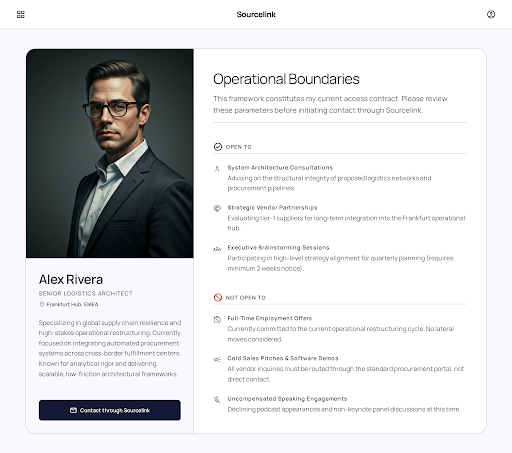
Intent, timing, open lane, and boundary fit are ready for review.
Built around controlled professional access
Ask for intent, timing, constraints, and fit before access reaches the owner.
Ask for intent, timing, scope, and constraints while the requester still has attention and context.
Turn inbound into a concise owner-side brief with fit signals and missing details.
Track profile views and request conversion without feeds, follower counts, or third-party analytics.
SourceLink is not another place to perform. It is a private path for serious opportunities to arrive with context and boundaries.
Discover how SourceLink turns a profile visit into a reviewable request.
A SourceLink Card states what the professional is open to, what is not a fit, and what context is required.
The requester explains why they are reaching out, what they need, and when they need it.
Structured answers become a private review surface for the professional behind the profile.
Owners can adjust availability and boundaries without turning inbound into a public performance loop.
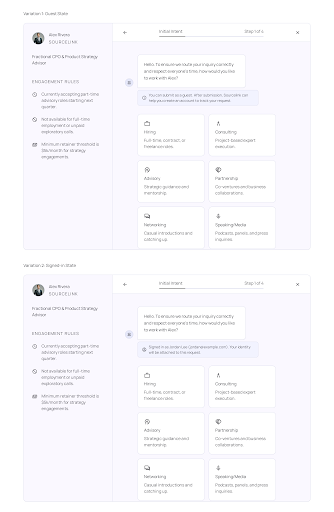
Where professional boundaries meet private request handling, designed to reduce inbound overload.
The requester sees boundaries before sending anything, which keeps low-fit outreach from becoming review work.
Requests are reviewed behind the profile without public threads, comments, likes, or reputation pressure.
Pick the surface you want to inspect first. No pricing, billing, or public social mechanics are part of v0.
For professionals who want their access terms discoverable.
For tagged mentions and profile visitors that should start with structured context.
For managing profile data, requests, routing, and availability.
Every inbound arrives with intent, context, and fit signals — ready for a one-minute owner decision.
Answers to common questions about the SourceLink v0 access layer.
No. SourceLink is an access layer: a professional card, guided request flow, and private review workspace.
No. The v0 intake is deterministic and bounded. It collects requester-provided context and prepares a structured brief.
The public path routes them through the profile's access terms and guided request flow before owner review.
SourceLink uses first-party product analytics language for profile views and request conversion, not social engagement metrics.
Open the example profile, review the access terms, then try the request flow for Alex Rivera.